

Good morning everyone, and welcome to edition #9 of El Boletín - your weekly newsletter of curated reading, listening and cultural snippets for Spanish learners (and lovers of the Spanish-speaking world).
We have a great edition to share with you this week, with no less than three guest contributors and two Spanish singers to explore. In our curated reading section, I’m delighted to welcome doctor, polyglot and author Alan Legarde, to share some of his atmospheric and spooky work - which you can enjoy and pick up some new Spanish vocabulary at the same time. While in our curated listening section, we join Spanish pop legends Malú and David Bisbal for a rendition of her song, Te Voy a Olvidar.
We then jump access the Atlantic for our curated culture section - as football author and podcaster Chris Lee recommends his top football-themed book in the Spanish language - giving his recommendation in English and in Spanish so you can practice a little more. And last but not least, we join Erika Andersen, who’s resident in Asturias and is “determined to become bilingual”. Erika shares her Spanish journey so far, along with her thoughts on using Duolingo and AI as part of the learning process.
So grab your Saturday morning cortados, and let’s dive in to the mundo hispanohablante together.
- Gareth
Curated Reading: La Mancha, Alan Legarde

A few weeks ago, I posted a note asking if any Spanish-speaking writers on Substack would like to feature their work in our curated reading section. And while several reached out, I’m delighted to say that Alan Lagarde, whose work is featured below, was recommended by other readers. And I can see why. His work is atmospheric, gripping, enjoyable to read, and for us Spanish learners, a great way to pick up some new vocabulary by diving into some literature that’s both challenging for non-native speakers yet still accessible.
I won't explain any of the story here, but will just say that if you enjoy the extract from his short story La Mancha below, be sure to check out the rest of it on his site. I loved it.
En esa época aceptaba cualquier trabajo nocturno con tal de no dormir. El insomnio era algo enquistado, una carga que venía arrastrando desde hacía años. Probé de todo, sin resultados. Así que empecé a trabajar en los horarios que nadie quería, en los turnos que todos evitaban.
El estacionamiento era un edificio gris, bruto, sin ventanas ni señales, encajado entre estructuras más nuevas. Tenía cinco pisos en superficie, siempre vacíos, siempre callados. Pero lo turbio estaba más abajo. El nivel menos dos había sido clausurado hacía años, después de un accidente del que nadie quiso hablar.
Pensé que las guardias nocturnas iban a ser tranquilas, casi mecánicas. Pero algo en ese lugar no cerraba. No era solo el silencio, sino la forma en que se estiraba entre las paredes: denso, irregular, como si tapara algo. Los pasos no sonaban igual que en otros edificios. Había rincones donde el eco no volvía. Sectores donde la oscuridad parecía más espesa de lo normal.
Desde entonces, nadie bajaba. Era un piso húmedo, sin señal, donde las cámaras dejaban de grabar por momentos. El menos tres ni siquiera debía existir. No aparecía en los planos, no tenía acceso marcado, pero algunos empleados sabían de una puerta sin cartel al fondo del menos dos.
Al principio era solo una molestia. Después, fue ansiedad. Parecía un error en las cámaras. Era apenas un manchón negro, amorfo, que se extendía lentamente sobre las columnas, como tinta volcada que se desparramaba sin prisa. No se parecía a una mancha de suciedad ni a un problema del lente: siempre aparecía en el mismo lugar, a la misma hora, sin importar cuántas veces revisara las grabaciones. Las 3:33 de la madrugada.
Curated Listening: Te Voy a Olvidar, Malú con David Bisbal
Not one, but two Spanish pop singers in our curated listening section this week, as we join Malú and David Bisbal in a live performance of her song, Te Voy a Olvidar.
Malú is one of Spain’s most enduring vocalists, and has built a career which blends pop, flamenco influence and emotional intensity - bringing raw vulnerability to her performances. Here, she is joined by David Bisbal, who rose to fame through Operación Triunfo - a Spanish singing contest, similar to American Idol or The X Factor. He’s since become an international star, noted for blending pop ballads with rthymic flair.
Together, their rendition of Te Voy a Olvidar becomes an emotional dialogue between two of Spain’s most recognisable voices. The lyrics, which you can read along with here, sing of heartbreak, resolve and moving on… delivered with a passion that feels quintessentially Spanish. And if passionate, pop ballads of heartbreak are your thing, stay tuned because next week we have an even better Latin American equivalent to share with you, too.
Curated Culture: Outside Write, Chris Lee
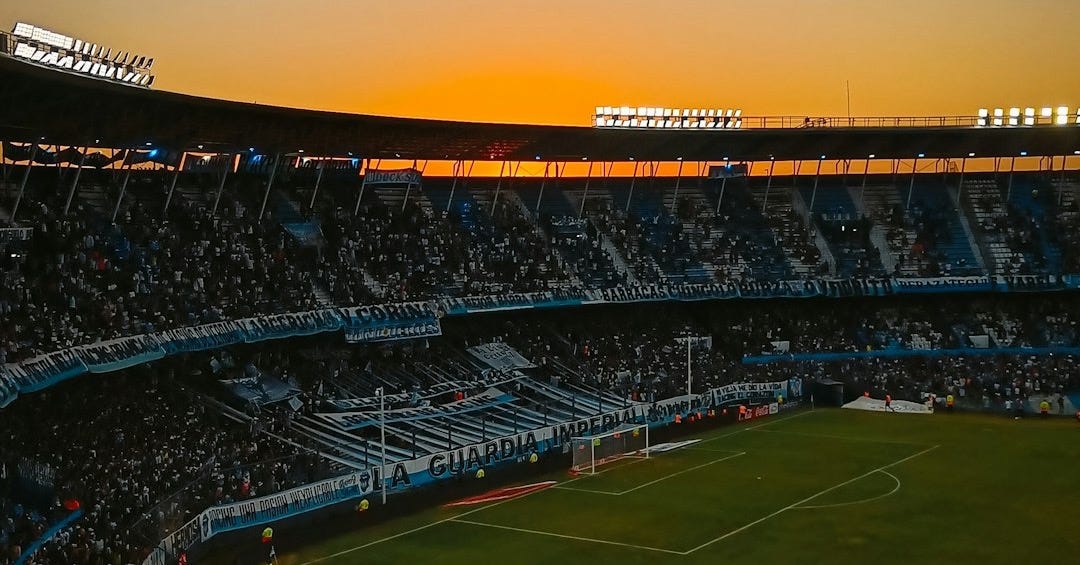
Something a little different in our curated culture section this week. Fresh from his Substack post about the best books about South American football, I asked football author and podcaster Chris Lee for a book recommendation about the same topic… but in Spanish.
His choice is a book that, as Chris says, “really needs to be translated into English”. And if you’d like to practice your reading skills before diving into the full book, he’s written his recommendation in English and in Spanish below, too.
Over to you, Chris!
My recommendation for a Spanish-language book, especially if you’re interested in the confluence of politics and sport, is El Partido (The Match) by Argentinian journalist, Andrés Burgo.
The book chronicles the story of the infamous quarter-final between Argentina and England at the Mexico ’86 World Cup. It was the first encounter between the two nations since the Falklands/Malvinas War in 1982 and was the match that propelled Diego Maradona beyond football with his infamous ‘Hand of God’ goal, followed five minutes later by the ‘Goal of the Century’.
Burgo interviews many of the players and staff from both sides, and it’s a great way to learn some Argentinian slang at the same time.
Mi recomendación para un libro en castellano, especialmente para ellos que les interesan la confluencia de la politica y el deporte, es ‘El Partido’, por el periodista Argentino, Andrés Burgo.
El libro cuenta la historia del infamoso partido entre Argentina y Inglaterra en los cuartos de final del mundial en Mejico ’86. Era la primera vez que los dos paises habían jugado desde la guerra de Las Malvinas/Falklands en 1982. Era el partido en cual Diego Maradona eleva por encima del deporte con su infamoso gol, ‘La Mano de Dios’, y cinco minutos despues, el ‘Gol del Siglo’.
Burgo hace entrevistas con muchos jugadores y la plantilla de ambos lados, y es una buena oportunidad para aprender el lunfardo Argentino.
Curated Community: Erika Andersen
Our next subscriber to share their Spanish learning journey with our community is business thinker, author and speaker Erika Andersen.
Erika writes a newsletter here on Substack entitled The New Old, in which she provides advice for those over 65 on how to live a life filled with purpose, connection, discovery, and joy. She lives in Asturias, Spain and in her own words, is “fully committed to being bilingual”.
Here, she shares why she decided to learn Spanish, her thoughts on using Duolingo and AI as a learning tool, and the importance of patience when it comes to learning a language.
Over to you, Erika!
When and why did you start learning Spanish?
When my book Be Bad First, about how to become a master learner, came out in 2016, I decided to learn Spanish as a big, juicy learning challenge that would allow me to practice what I was preaching. My husband suggested that we vacation somewhere that people spoke Spanish, so I could practice. I read a few articles about the Costa Verde, in the north of Spain, and was intrigued - it sounded very different from the south. Then I read an article about Asturias, and it sounded fascinating. In 2017, we rented an airbnb near Villaviciosa, and fell in love with Asturias (where we now live).
What advice would you give to other Spanish students?
I’d say, get a grounding in the language in whatever ways works for you. Duolingo has been my go-to for nine years, but I know others don’t like it - so find an approach that appeals to you and that you’ll stick with. But then, as soon as possible, start having conversations. One of the benefits of current AI is that you can start conversing with AI chatbots (on Duolingo or other apps) in a no-risk, no-embarrassment way even when your Spanish is pretty basic. And then find other ways, that you enjoy, to bathe your brain in Spanish: read books, listen to music, subscribe to a newspaper online. Watch Spanish TV, first with English subtitles, then with Spanish subtitles, then with none. The important things are to listen and talk, in ways that feel fun and not too over whelming to you.
What’s your proudest or most memorable moment you’d had using the language?
In October, I got a call from a journalist in Oviedo (the capital of Asturias, and the city where we live) who wanted to interview me about my latest book, The New Old, and about why we moved to Spain. I’d met her when she asked me a few questions after the Día de America parade in Oviedo in September, where we had marched with an expat group to which we belong. She and I got together and she interviewed me for about an hour, which meant I was talking for most of that time. It felt like a real stretch - I wanted to be clear, articulate and engaging, and all in Spanish off the top of my head. It was exhilarating and a little scary. And the article turned out well!
What have you found most difficult, and how do you deal with that?
My own expectations and impatience. I want to be as fluent in Spanish as I am in English, RIGHT NOW! So, I continually have to remind myself that it’s a journey, that Im progressing, and that even now I can do most of the things I want to do in Spanish.
What do you hope to achieve by subscribing to El Boletín?
It fits perfectly into my strategy of ‘bathing my brain in Spanish’, and I hope to learn things from other subscribers, and perhaps I can be useful to them, as well.
That’s all for this week, Spanish learners! If you'd like to show your support for the newsletter, please do help us grow by sharing it with just three fellow learners, who also feel the joy of learning Spanish and discovering the Spanish-speaking world.
And if you’d like to continue the conversation - why not get involved and share your own book reading recommendations or favourite songs in the comments below? You can also reach out to me directly by replying to this email or sending me a message on Substack. I’d love to hear from you.
Hasta la semana que viene,
⁃ Gareth
I love how El Boletín keeps widening the doorway into the Spanish-speaking world.
This edition moves beautifully — from La Mancha’s eerie quiet to Malú’s emotional fire, then all the way to Maradona and Asturias.
It’s the kind of curation that reminds you Spanish isn’t just a language, it’s a whole ecosystem of stories, rhythms, and landscapes.
Gareth - thank you so much for asking me to share my Spanish-learning experiences!
And, if I may, two very Asturias-centric recommendations: first, La Regenta, by Clarin, considered the premiere Spanish novel of the 19th century. It takes place in a city called Vetusta, which is a very thinly-disguised Oviedo. It was considered highly scandalous when it was published - in fact, had to be published in Barcelona because no publisher in Oviedo would touch it.
Second, the music of Melendi - one of the most popular singers in Spain (born and raised in Asturias). I love his music and his vibe!