

Good morning everyone, and welcome to edition #10 of El Boletín - the final weekly newsletter of curated reading, listening and cultural snippets for Spanish learners, before the newsletter takes its Christmas break for December.
It’s been a busy week on my Spanish learning journey personally, with no less than three Spanish C2 exams (covering reading, listening and oral tests respectively). But fear not - we have a cracking edition of El Boletín to close the season with.
We open with something a little different for our curated reading pick - with beloved Argentinian comic strip character Mafalda - resulting in a section which is low of dense literary text, but high on humour and satire. We then move on to enjoy another passionate pop ballad in our curated listening section - and I defy you not to spend the next week trying to get this one out of your head.
Our curated community contribution this week comes from Esther Harder, who shares her Spanish-learning journey from high school in the US, to raising a bilingual family with her Mexican husband. And finally, we end the season with a film pick in our curated culture section, as eight-year-old Moncho navigates childhood in 1930s Galicia.
I hope you enjoy.
- Gareth
Curated Reading: Mafalda, Joaquín Salvador Lavado (‘Quino’)
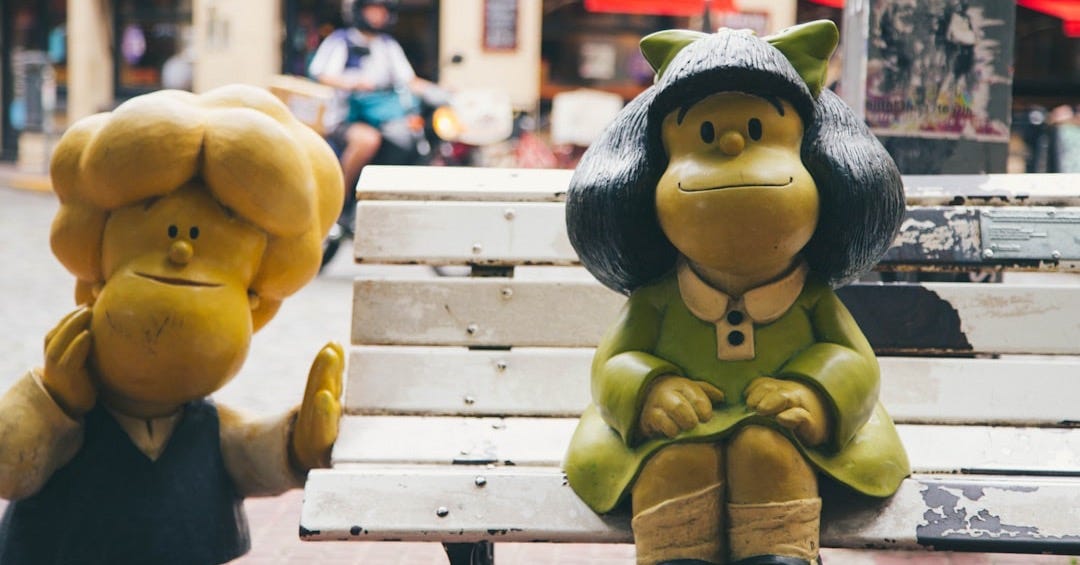
Of the many places I’ve visited and taken Spanish lessons, Mendoza in Argentina must be one of the most beautiful - and an absolute must if you enjoy your wine. In truth, the quality of teaching I had there was mixed: one teacher, close to retirement, would rock up with his newspaper under his arm, ask me if I liked football, and then ask me to read out the Argentinian football articles to “practice my pronunciation”. To this day, I’m not sure if it was for his benefit or mine.
But another teacher, who introduced me to some incredible Argentinian films which I’ll share in a future edition, also opened my eyes to the world of Mafalda - an iconic Argentinian comic-strip character created by cartoonist Joaquín Salvador Lavado, better known as Quino, in the 1960s.
Presented as a sharp-witted, socially conscious six-year-old girl, Mafalda quickly became a cultural symbol across Latin America and beyond. Through her innocent yet incisive questions, she reflects anxieties about world peace, politics, inequality, and the contradictions of adult society. Her comics are humorous on the surface, but they carry a strong undercurrent of social critique, mirroring political tensions and global issues.
Surrounded by a memorable cast - such as the consumer-minded Manolito, the conservative and marriage-obsessed Susanita, and her sweet, shy little brother Guille - Mafalda’s world allows Quino to contrast different ideologies and personalities in playful yet profound ways.
Although the original strip ended in 1973, and Quino himself died a few years ago, Mafalda’s relevance endures. She remains a beloved figure whose curiosity, empathy, and rebellious spirit continue to resonate with readers who see in her a timeless voice calling for a better, more humane world. So if you’d likee to do some light-touch Spanish reading practice this week, I encourage you to check out some of Quino’s work.
Curated Listening: Fuiste Tú - Ricardo Arjona ft. India Martínez
Hot on the heels of last week’s curated listening choice of a Spanish pop ballad from Malú and David Bisbal, this week we hop across the pond to enjoy another ballad - this time by Guatemalan singer-songwriter Ricardo Arjona.
Arjona has long been considered one of Latin America’s most distinctive storytellers - using poetic lyrics to explore themes of love, memory, contradictions, and the everyday complexities of human relationships. Over a career spanning more than three decades, he has built an immense following across the Spanish-speaking world, admired not only for his unmistakable voice but also for the emotional precision of his songwriting.
Our specific curated listening choice this week is his song Fuiste Tú - an intimate, melancholic dialogue between two people navigating the ruins of a love that has ended but refuses to fully fade. The lyrics unpack both the blame and bittersweet nostalgia that linger after a breakup, capturing the moments when both partners quietly admit their own share of responsibility.
Upon its release, the song performed strongly across Guatemala, Mexico, Argentina, and Chile, and quickly became a staple of contemporary Latin pop. Although the song was originally recorded as a duet with Gaby Moreno, this live performance features India Martínez. At the start of the second verse, you can almost feel her give up arguing - emotionally exhausted as she walks barefoot at night, the way being lit up only by neon lights.
This passion - matched by the passion of the crowd - make this video one not to miss. As always, you can read along with the full lyrics here.
Curated Community: Esther Harder

Our final curated community contributor of the season is Esther Harder. Esther is a memoir book coach specialising in stories that cross cultures and languages - and if you’re wondering what exactly a book coach does, there’s an explanation at her substack, Write Like An Outsider.
Here, Esther shares her Spanish-learning journey - from high school in the US, to raising a bilingual family with her Mexican husband. On the way, she notes the trick of building vocabulary in areas you’re actually interested in, and the importance of building a community of fellow Spanish learners.
Over to you, Esther!
1. When and why did you start learning Spanish?
My tiny hometown high school offered a Spanish class for 9th grade, and I jumped at the chance to start a language a year ahead of the other languages they offered. I had a very short-term goal, which was to understand the calls going on during the pick-up soccer games in our city park. Later on, my Spanish language goals broadened; my sister-in-law is Bolivian, and my husband is Mexican, so we are trying to create households where we can flow back and forth from Spanish to English.
2. What advice would you give to other Spanish students?
My 9th grade self understood a key concept: Learning a language while participating in a shared activity can cement learning far more quickly than studying a book. Maybe soccer isn’t your thing, but you can find other people who are fans of your thing with some work. You’ll gain some very specialized vocabulary that you are uniquely interested in, and you’ll have a whole lot of fun while doing it.
3. What’s your proudest or most memorable moment you’d had using the language?
My child’s first words and phrases were in Spanish rather than English. As his primary caregiver, I take great pride in the effort I put in to cement that early learning despite my many misgivings that I was making silly mistakes or teaching him to mimic my less than perfect accent. Those mistakes don’t matter in the long run; the fact that we were sharing life in Spanish far superseded an improper conjugation here and there.
4. What have you found most difficult, and how do you deal with that?
My main challenge is that now that my child has outgrown the age where we would hang out at the park for hours on end and I could chat with the other caregivers in Spanish, I do not have a readily available Spanish conversation practice built into my day, so I continue to struggle to find ways to push my language learning ahead in one-on-one conversation. I will give a plug for Habla Institute in Mérida; we spent a month there this summer, and they had great, leveled programs for children as well as adults.
5. What do you hope to achieve by subscribing to El Boletín?
Community! Finding others who are struggling with similar language learning issues and sharing resources is great. It’s nice to know I’m not alone and we can continue together.
Curated Culture: La lengua de las mariposas
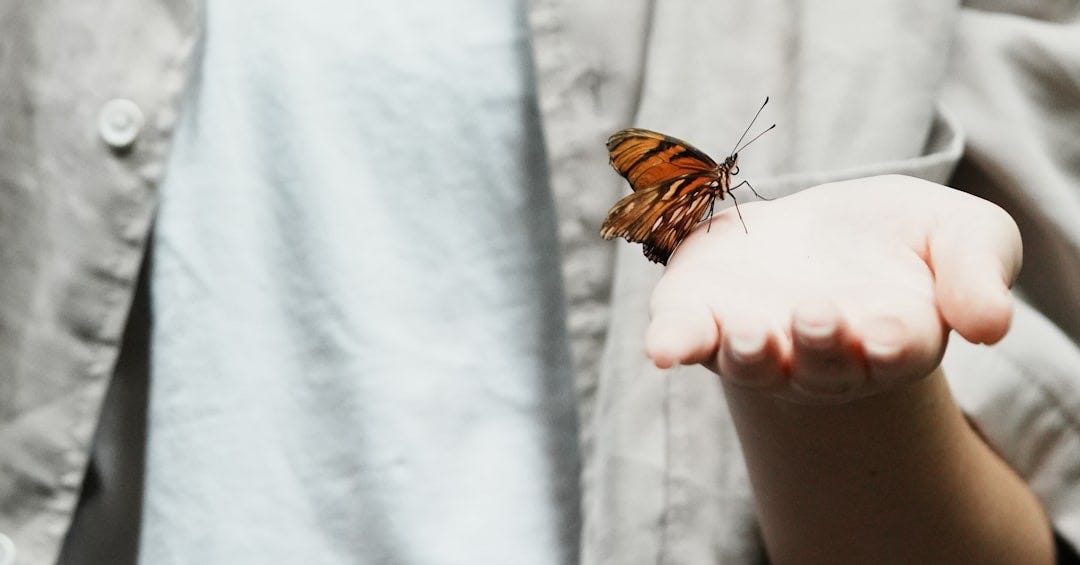
Back when I was learning Spanish at B1 level, I used to use a textbook series where each chapter was divided into sections. Each would start by introducing the key vocabulary, move on to grammar, followed by exercises to help you practice those points. And each chapter would close with a cultural snippet — a song, a film, or an insight into everyday Spanish life. It’s that last cultural section which I used to most enjoy - because it felt like a ticket to go on an adventure to a whole new world. It was also the inspiration for El Boletín.
I remember one chapter touched on Spanish cinema, and while I adore the work of Almodóvar as much as the next person (and he’ll definitely feature in a future edition of the newsletter) - my curated culture pick this week is the film La lengua de las mariposas.
Set in 1930s Spain (in a small village in Galicia) just before the outbreak of the civil war, La lengua de las mariposas follows Moncho, an eight-year-old boy. The film shows how Moncho - shy, asthmatic, and nervous about starting school - comes under the care of Don Gregorio, his new teacher. Unlike the harsh teachers Moncho had heard about, Don Gregorio is patient, open-minded, and encourages learning through curiosity, nature, and kindness rather than fear. Over the course of the film, Moncho blossoms intellectually and emotionally: he begins to appreciate literature, nature (even learning the Spanish word espíritrompa — “butterfly’s tongue”), and the beauty of observation.
But as the political situation in Spain deteriorates, the peaceful rhythm of village life is shattered. The rise of the conflict leads to arrests, fear, betrayal - and Moncho’s world is abruptly transformed.
I love this work for two reasons. Firstly, because for a language learner, the content is just accessible enough for an intermediate student, especially with subtitles. I remember it being the first time I’d achieved such a feat on my Spanish-learning journey, and feeling such a sense of achievement. Secondly, I love the juxtaposition in the film: on one hand, the everyday experiences of a primary-school aged boy - those first awkward days at school, curiosity, friendship, innocence - and on the other hand, the shadow of a looming civil war, political intolerance and violence, which Moncho cannot fully grasp.
At once, the film presents a cultural insight into pre-civil war Spain that is very specific to its time and place, alongside the very universal experience of growing up that we can all relate to. I’m delighted to be able to recommend it to you all.
And that brings us to the end of this first season of El Boletín! If you’re a fan of Mafalda, Ricardo Arjona or La lengua de las mariposas - or you have another song or film to recommend to our community of Spanish learners - why not continue the conversation in the comments below? We’re always happy to include reader recommendations in the newsletter.
I’d like to also take this opportunity to thank you all for supporting the newsletter since it launched just ten short weeks ago. In that time, we’ve gone from zero to a community of over 300 language learners, exploring the Spanish-speaking world together. Please do continue to spread the word and encourage your friends and family to subscribe.
El Boletín will be back from 3 January for the next season - but in the meantime, os deseo una feliz Navidad y un próspero Año Nuevo.
⁃ Gareth
Interestingly, there's also a statue of Mafalda in our city of Oviedo, in Asturias. Here's an artile about how and why that happened: https://www.20minutos.es/viajes/destinos/curiosa-historia-estatua-mafalda-oviedo-5080237/
Another great edition! It’s cool to see things from many different Spanish speaking countries so that Spanish learners can understand the nuances between pronunciations and vocabulary from place to place. No two countries (or even regions within the same country) speak Spanish in the exact same way!